

PETAR CHAULEV (1882-1925)
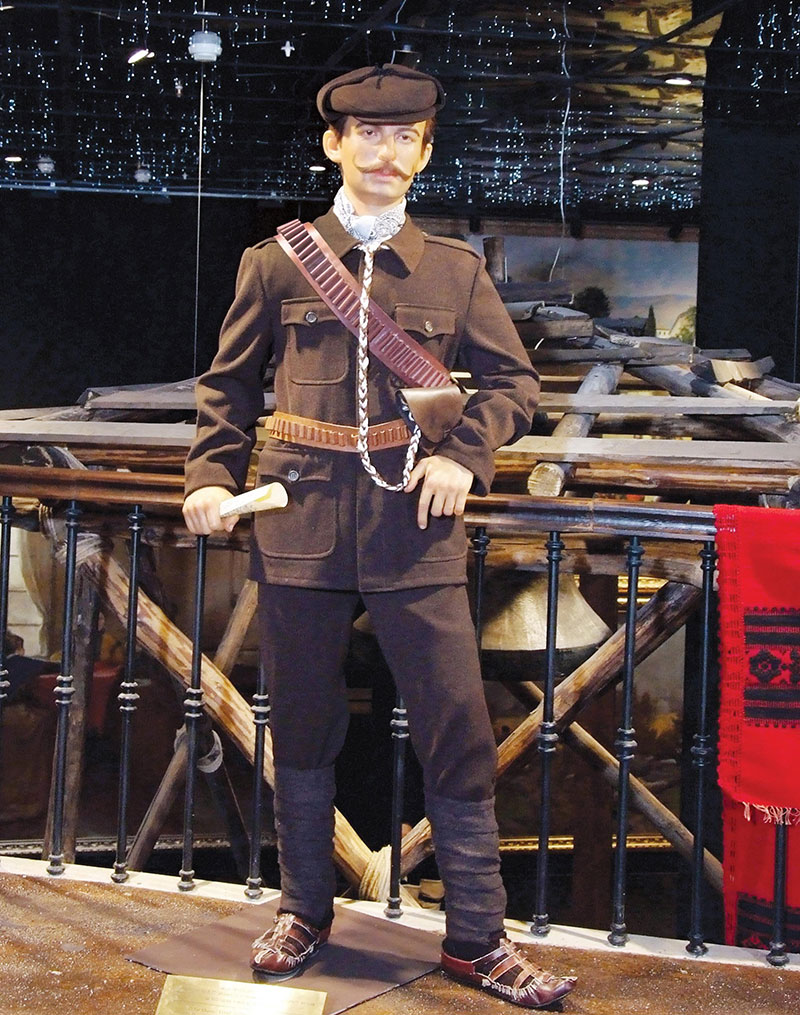 He was a revolutionary, teacher and Ohrid voivode. In 1899 he was appointed organizer of revolutionary committees in the Ohrid, Prespa and Lerin regions. During the Ilinden Uprising he acted in the Ohrid region, and after the Uprising he fled to Bulgaria. In 1911 he was elected a member of the Central Committee of the VMRO together with Todor Aleksandrov and Hristo Chernopeev, and in 1913 he was one of the organizers of the Ohrid-Debar Uprising, raised against the Serbian authorities in divided Macedonia. In 1915, during the First World War he was appointed district chief of Ohrid, and after the First World War he was one of the founders of the VMRO (autonomist) together with Todor Aleksandrov and Aleksandar Protogerov. In 1924 he was a signer of the May Manifesto which envisaged the unification of Macedonian organizations and joint action in cooperation with the USSR and the Comintern. In 1924, he was murdered in Milan, Italy, as one of the victims of the mutual conflicts and fratricides in the Macedonian revolutionary movement.
DIMITRIJA CHUPOVSKI(1878-1940)
He was a Macedonian historian, ethnographer, cartographer and publicist, teacher, founder and co-founder of societies among Macedonians in Petrograd (St. Petersburg) and a participant in the October Revolution. He studied at the Novogorod and Petersburg Theological Seminaries where, meeting other Macedonian intellectuals, he participated in the formation of the Macedonian-Scientific-Literary Fellowship “St. Clement”. The fellowship aimed to develop national consciousness among its members and to study the language, songs and customs and history of Macedonia from an ethnographic and geographical perspective. In 1913, as a consequence of the First Balkan War, Chupovski sent a Memorandum and Map of Macedonia in order to demonstrate to the great powers that the division of Macedonia would make peace on the Balkan Peninsula impossible, emphasizing that it was necessary for the Macedonian territory to be formed as a separate state in a Balkan federation that would ensure peace in the Balkans. The group around Dimitrija Chupovski also published the newspaper “Makedonski glas”, and from 1917 he was the founder of the Macedonian Revolutionary Committee, which published the manifesto “Balkan Federative Democratic Republic” as a joint program declaration of the Macedonian comradeship “St. Cyril and Methodius” and the editorial staff of the newspaper “Makedonski glas”.
